
Ordinary Objects as Lifelines, Ordinary Days as Ceremony
What nine years of seventh-grade poetry taught me about how healing actually travels
As one of the Spanish editors of More Odes to Common Things, Volume IX, the first time I get to read these poems they arrive to me by email in a google doc, formatted in columns with a name at the bottom. Nothing fancy. Still, the power of these young poets' words finds me in the comfort of my recliner chair, settles alongside me, and takes me on a journey. A journey where I not only get to understand their story but get to heal mine as well.
You see, these poems and these poets are not simply poems and poets. First, the poem is medicine for the poet, who becomes a time traveler as they choose which parts of their history to write about, which is to say, which parts to heal. Then the poem itself becomes the time traveling machine that carries the medicine to the reader, into the reader's story, and mends theirs. In this sense these young poets are doing the biggest service to their community.
I worked at Monarch School Project for five years in various capacities, and I had the privilege of personally knowing many, if not all, of the poets in the books I have edited. Except this one. I left Monarch three years ago. Usually, when I am editing in the comfort of my home, I know whose poem I am working on just by reading the name. This year I did not.
At first I was deeply saddened by the realization. I questioned my right to access such precious medicine at all. It was only after I let my ego throw its tantrum and decentered myself that I understood. The not knowing is not the loss. The not knowing is the design.
David Denborough calls this collective narrative practice. Working with communities who have survived hardship, he describes documents of skill and survival that travel from one community to another, from Port Augusta to the Yolngu communities of the north, between people who will likely never meet. What he found is that the exchange itself does the work. When young men from Yirrkala learned their story had made a contribution to the lives of other Aboriginal people, it changed how they felt about themselves and about each other. Denborough's argument is that the healing is not in the telling. It is in being positioned as a contributor rather than a recipient. Being of use is the medicine.
Which means the poem never needed me to know the poet. It was never going to be mine to hold. It was always going to travel.
Every year for the last nine years, Rick Shaughnessy has gone into Ms. López's seventh grade classroom and helped students reflect on the ordinary objects in their lives that are, in fact, lifelines. What comes out of that classroom is nothing short of profound wisdom, and a reflection of the power of collective thought and collective healing. This year's volume holds odes to video games and to being a kid, and inside those ordinary objects: a father gone since infancy, a sister who took custody at ten, a border a child cannot cross to see a parent, a Dora the Explorer backpack packed with toy doctor things. Ordinary objects. Life lines.
On August 13th, 2026 we gathered on the ninth floor of the San Diego Central Library to launch the book. The poets read at a standing microphone, one at a time, downtown behind them through the glass. The room was full of families, staff, strangers. Barbara Myerhoff, the anthropologist Denborough builds on, called this a definitional ceremony: a gathering where people tell their story in the presence of outsider witnesses whose job is not to evaluate but to say what caught them, what images it raised, and how they were changed by hearing it. That is what a book launch is, when you look at it plainly. A room organized so that a seventh grader can watch a stranger be changed in real time.
But once you have the word, you start finding the thing in smaller rooms.
Nine years of Rick walking into that classroom is not the ceremony. That is a ritual. Ritual is repetition that becomes safety and trustworthiness. The same man, the same room, every year, whether or not anyone is watching. And ritual is what makes ceremony possible. A seventh grader does not stand at a microphone in front of a room of strangers because someone designed a good afternoon. They stand there because someone kept coming back.
So the ceremony is the launch, yes. And the ceremony is also smaller and far more frequent than the launch. It is every time he sits down beside a student and listens, and writes down what they said, and reads it back, and polishes it with them until it sounds like them and not like him. That is a definitional ceremony with an audience of one. The launch is that same act with the room finally full.
The research is catching up to what that room already knew. A 2025 synthesis in the Journal of Poetry Therapy reviewed forty six studies on collaborative poetry in groups and named three mechanisms that solitary expressive writing does not reach: dialogic agency, mutual witnessing, and ritualized transformation. Their phrase for what a reading does is exact. It converts audience into witness.
Afterward there was cake, and a great deal of laughing, and photographs of people holding a small plum colored book with gold letters. Both registers in one afternoon. The grief and the cake. I do not think that is a contradiction. I think that is life.
So here is what I understand now that I did not understand in my recliner chair. The healing is in the circulation, not the confession. A poem written and kept is a private act. A poem written, translated, printed, read aloud, and shelved where anyone can find it is an intervention.
And the intervention did not happen on the ninth floor. The ninth floor was the day we could finally see it. It happened on all the ordinary afternoons before it. A man in a chair. A student talking. A pen moving. And it keeps happening every time someone opens the book.
If you are in San Diego, all nine volumes are at the Central Library. Go check one out. You will be the outsider witness. That is a real job, and these poets did the harder half already.
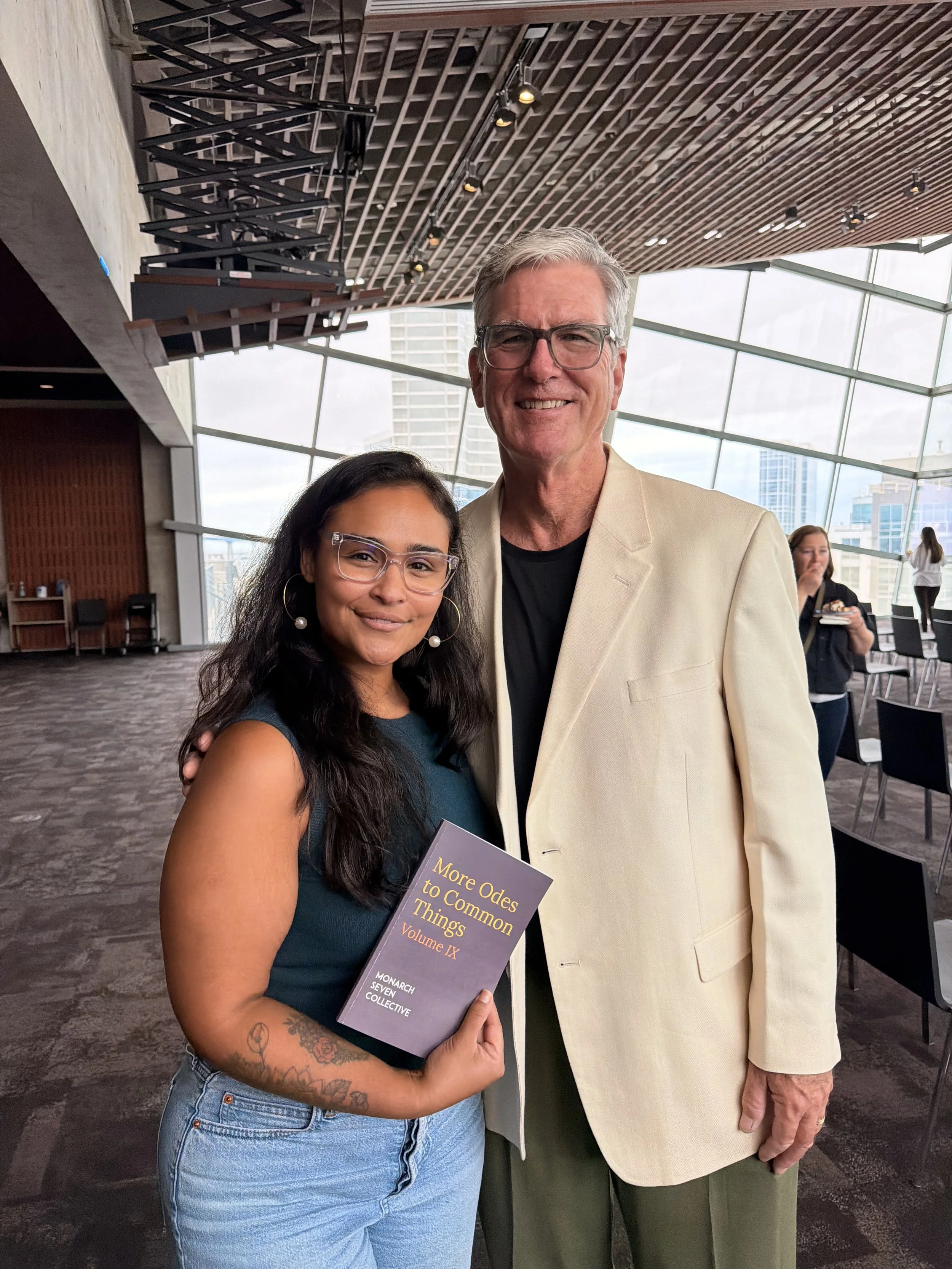
Delia & Rick at the San Diego Central Library
NOTES ON SOURCES
David Denborough, Collective Narrative Practice: Responding to individuals, groups and communities who have experienced trauma (Dulwich Centre Publications, 2008), Chapter 3, "Enabling contribution: Exchanging messages and convening definitional ceremonies," pages 52 to 70. Builds on Barbara Myerhoff's concept of the definitional ceremony.
Mohammad Rahmatullah, Tasnim Alam Mukim and Muztaba Rafid, "From silence to collective voice: collaborative poetic transcription as a paradigm shift in group based poetry therapy," Journal of Poetry Therapy (2025). DOI 10.1080/08893675.2025.2553634.
More Odes to Common Things / Más Odas Elementales, Volume IX, by the authors of the Monarch Seven Collective. Edited by Rick Shaughnessy. Spanish language editors Sally López and Delia Sáenz Skinner. Monarch Seven Collective, San Diego.
